
Searching Madison County Criminal Dockets
Missouri Case.net should be your first stop. It is the state judiciary's public portal for case information. It covers Madison County Circuit Court criminal matters too, including cases in an associate or assigned criminal division. When a Madison County record is confusing, skip county administration entirely. The Madison County Circuit Clerk is the court-records office. That office can point you to the right public docket sheet or division.
Match any result carefully. Check the case number, county, division, filing date, case type, and the Madison County case header together. A shortened charge label tells you nothing about offense level. Nor does a similar name prove you found the right party. A linked docket entry may open a document. An unlinked one may simply mean nothing is attached or available in that public view.
- Open Case.net and choose Case Number Search when a citation, notice, or court paper supplies the number.
- If the number is unknown, use Litigant Name Search and compare the public header with the known Madison County context.
- Open the matching Madison County case and read the dated docket entries in chronological order.
- Separate the charge and filing entries from later settings, pleas, orders, judgments, and sentences.
- Ask the Madison County Circuit Clerk about a Madison County public docket printout, a courthouse-terminal view, or a certified copy when the public result is incomplete.
One caution is worth knowing before you plan a trip. Public Case.net access and true electronic-file access are not the same thing. Missouri's eFiling guidance allows the public to use a courthouse terminal in Madison County for electronic public cases and documents. Staff login and security controls still apply, though. So ask two questions before you go. Is the file paper or ECASE? Is the item you want actually public? The answers save a wasted trip or a copy request that goes nowhere.
Use the Exact Case Number First
Court Operating Rule 4 recognizes more than one generation of Missouri case numbering. A Madison County file might carry an older criminal category like R. It might show an interim one like CR, or the newer format mixing year, location, category, sequence, and possible subcase parts. Trust the Madison County case header on the record, never a guessed pattern.
Searching by case number cuts down same-name mix-ups. It also keeps a Madison County criminal case separate from a traffic, municipal, or civil record that shares a party's name. And if all you have is a uniform citation number, compare it with the court case number. Do not assume the two match. When the number is unknown, the official public Case.net workflow offers filing-date and scheduled-hearing searches.
A filing-date search works when a rough window is the only solid fact you have. Scheduled Hearings & Trials Search answers a date question instead. Neither tool can safely guess a person's identity. Whatever comes back, confirm it against the Madison County case header. Then check the dated entries that follow.
Inside a Madison County Criminal Docket
Court Operating Rule 4 sets out what a Madison County docket actually records. Think of it as a chronology and an index in one. You get the case identifier, parties and attorneys as publicly displayed, the date and type of each filed document, plus court action like orders and judgments. Short sentences. Limited scope. The docket is not necessarily a complete electronic file. An entry's wording may be briefer than the order it points to, so read the underlying document before drawing conclusions.
| Case Number | The Madison County court identifier, which may include a criminal category such as CR; copy it exactly. |
|---|---|
| Charge | The accusation or offense description as recorded. A charge is not a conviction. |
| Settings | Dated arraignment, motion, pretrial, trial, sentencing, review, or other court events. |
| Plea and Judgment | Separate procedural entries that should be read with their dates and any linked order. |
| Disposition and Sentence | The recorded resolution and, when entered, the court’s sentence or other resulting action. |
Start at the top of the page. The header tells you more than any single line under it, and party filings should always be separated from judicial action as you read. A date beside a docket entry could be a filing date, a setting date, an order date, a judgment date, or a later disposition date. Do not turn it into an arrest date, a custody status, or a final result the entry never states. The text says what it says.
Backer Sheets Explain Citation Cases
The Court Operating Rule 4 recordkeeping material lays out the standardized backer-sheet fields that go with Madison County uniform citations. Each sheet captures the case number, charge, filing date, bond type and amount, court and notice dates, warrants, disposition, sentence, and related certification or probation details.

Those fields answer a common puzzle. A Madison County citation record can carry several different date types and status lines because the backer sheet tracks each of them. A Case.net display may abbreviate the picture, though. The Madison County Circuit Clerk can tell you whether a fuller public backer sheet or file component exists for the case.
How a Criminal Case Moves
A Madison County criminal docket shows progression, not one final label. The timeline usually starts with a charge filing. From there it runs through arraignment, pretrial motions, and more settings. Then comes a plea or trial, disposition, judgment, and sentencing. Later entries can add probation, payment, appeal, or satisfaction events. None of these rewrite what the earlier lines meant.
Docket flow: Charge Filed › Arraignment › Pretrial Settings › Plea or Trial › Disposition › Sentencing
Keep four things distinct: a plea, a finding, a judgment, and a sentence. Each means something different in a court record. Dismissal, nolle prosequi, and suspended imposition of sentence also carry consequences of their own. Those consequences are both legal and record-based. So read the entry text and its date rather than trusting a broad status label.
The Court Docket Is Not a Police File
RSMo § 483.075 spells out circuit-clerk duties: recording judgments, rules, orders, and proceedings, issuing process, and accounting for court money. In Madison County, that court-records work belongs to the Circuit Clerk, Tenia Hermann, whose office sits at the Justice Center. The clerk is the office to contact about docket questions.
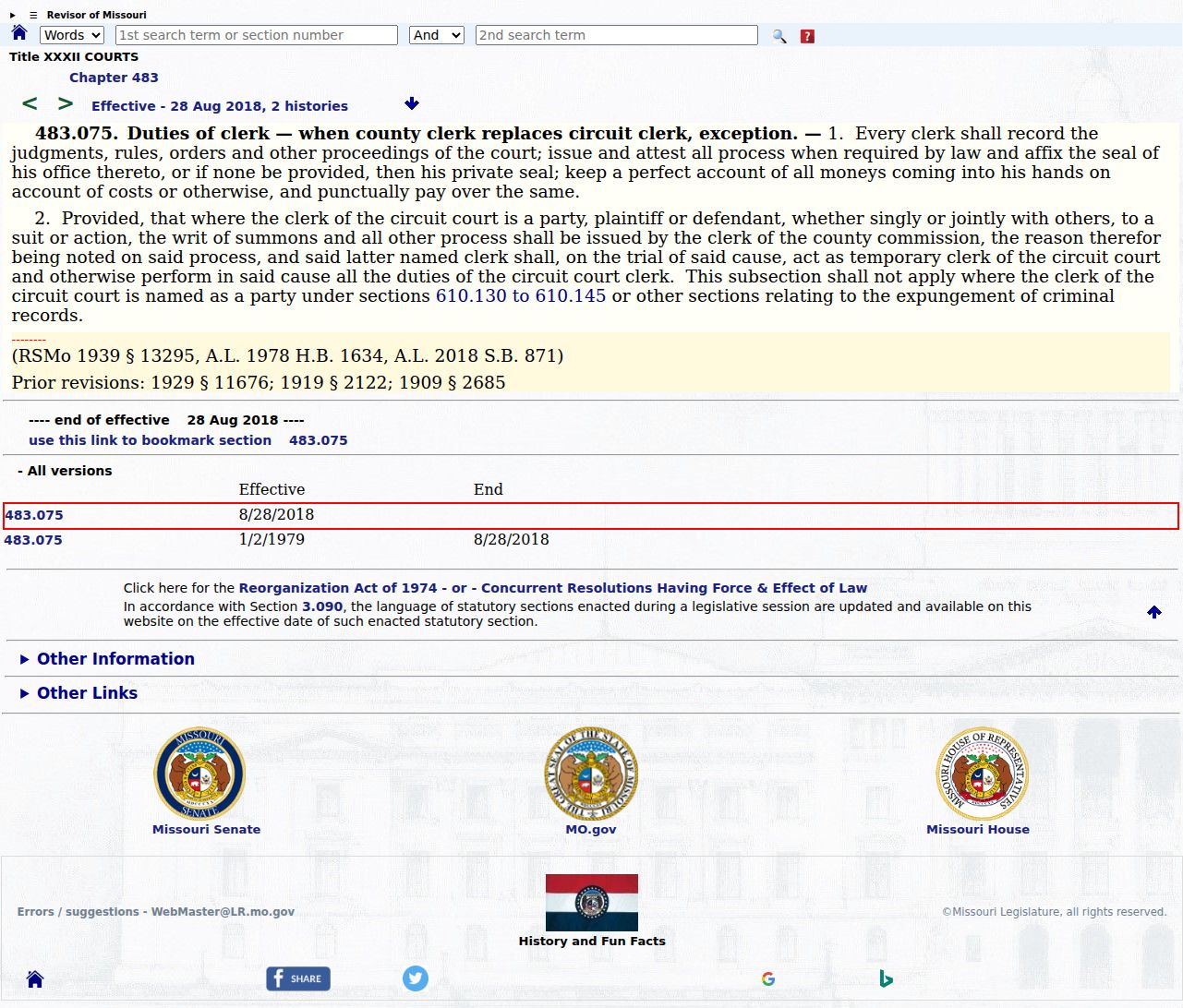
A Madison County court docket comes from the Circuit Clerk. That office does not hold every criminal record. Police reports, jail and booking files, dispatch logs, prosecutor work files, and driver records often sit elsewhere. Those files belong to other agencies. So name what you need. Ask the clerk for the docket sheet, the charging instrument, a judgment, or a specific public filing rather than a vague request for a complete criminal record.
Courts That Hold Criminal Dockets
Where a Madison County criminal docket lives depends on the charge. Felonies usually sit in a circuit criminal division. That division belongs to the Circuit Court of Madison County, Missouri. Misdemeanors and lower-level matters may go to an associate division or another circuit division. Municipal ordinance-criminal cases land in municipal divisions of the circuit court. Check the case type and division in Case.net first. Then confirm with the Circuit Clerk, because a case caption alone can mislead. An appeal from a Madison County case travels a separate path to the Missouri Court of Appeals, Eastern District, unless the Missouri Supreme Court has jurisdiction. The trial-court docket may list a notice of appeal. It still does not show the final appellate result. Do not send a public criminal lookup to the County Clerk just because the case is in Madison County. That office keeps county-administration and election records, not court files. The sheriff, the prosecutor, and police agencies each hold their own records. For court docket questions, orders, judgments, and public file matters, the Circuit Clerk is the custodian.
Read Warrant Entries by Date
A Madison County docket can record a warrant, a bond, a failure-to-appear event, or later court action. It is not a live custody or warrant-status system. A line saying a warrant was issued tells you nothing about whether it was served, withdrawn, recalled, or resolved. It only records that issuance happened. For a current-status question, read the date-specific Madison County docket history. Then call the clerk or agency that holds the current information. The same caution applies to a case marked closed or disposed. Later entries for payment, review, probation, appeal, or correction can still appear on the docket. Chronology beats any one-word reading of a single entry.
Sealed Dockets and Public Access
Missouri's open-court principle and the Sunshine Law favor public access. Yet court rules, statutes, and access orders govern judicial records. A case header can be public while an attachment stays restricted. A restricted case may never surface in an ordinary name search. Case.net, remote document access, and a courthouse public-access terminal are three different channels. They are not interchangeable ones. The Missouri Attorney General notes that judicial records get separate treatment under the Sunshine Law framework. Send any request to the custodian that actually holds the record. Be precise. For court material, that usually means the Circuit Clerk, asked about the docket, a public filing, a certified copy, or the access status of a specific record.
Key Rules:
RSMo § 476.170 recognizes public court proceedings, subject to lawful closure.
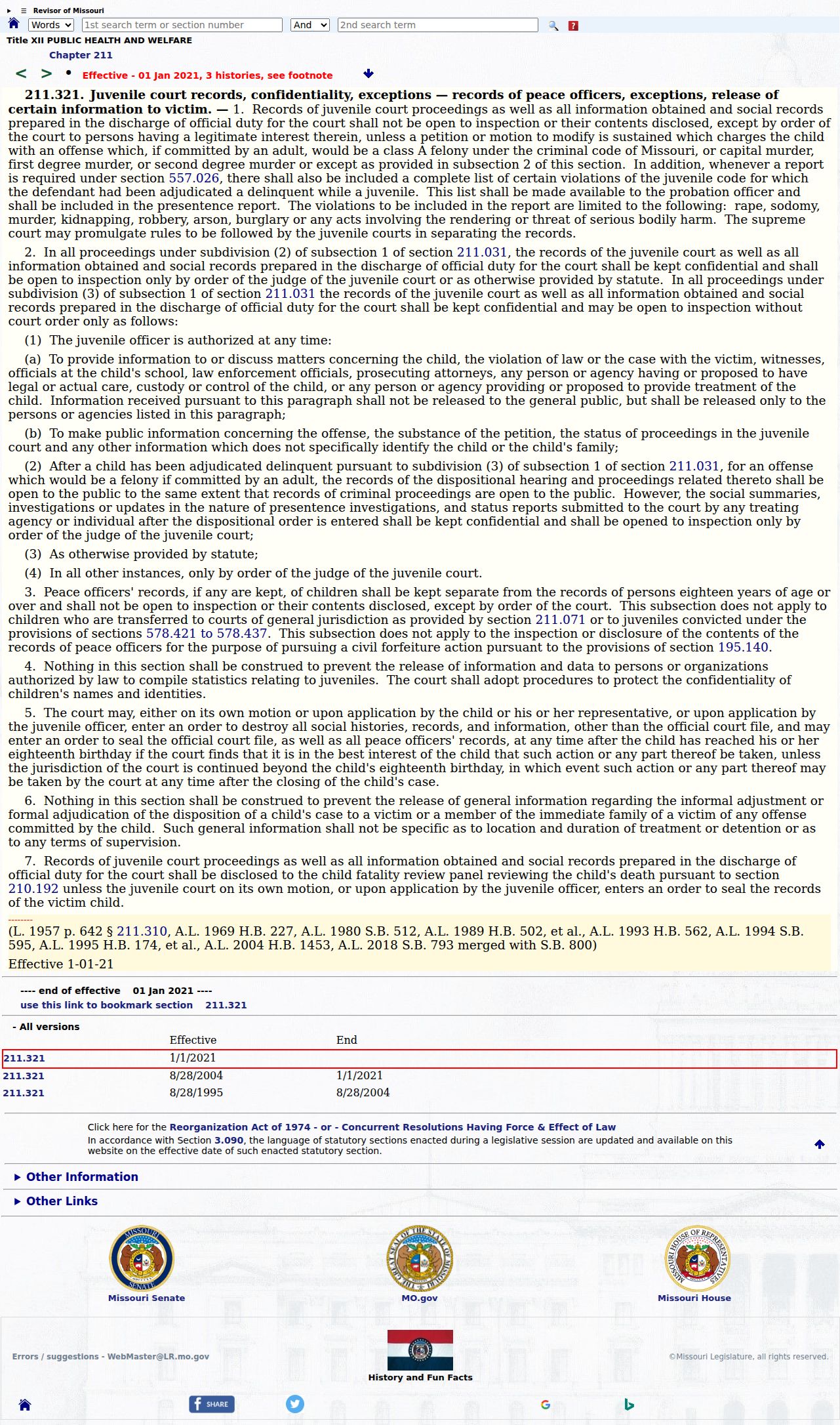
RSMo § 211.321 makes juvenile records a restricted category rather than ordinary public docket material.
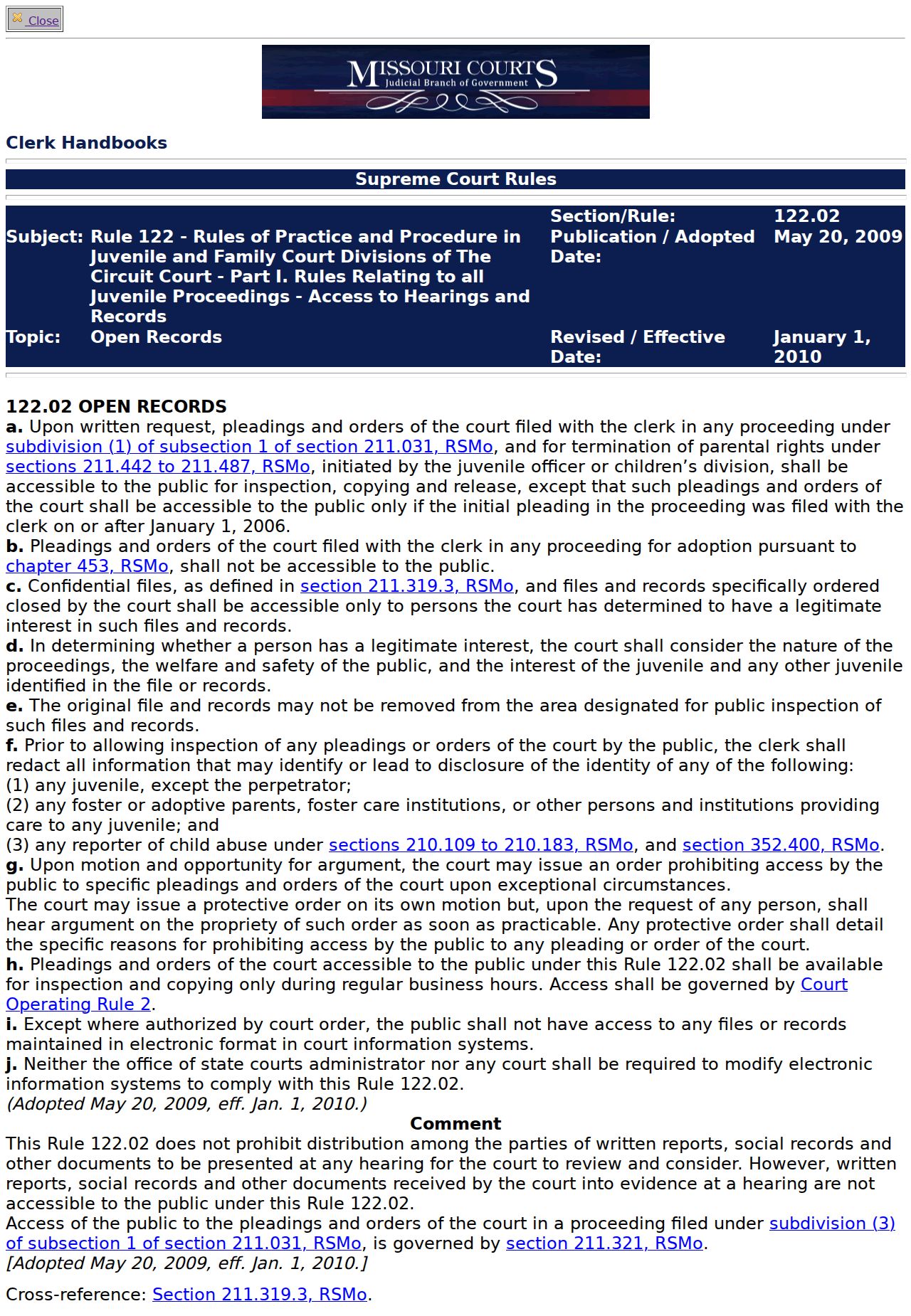
Missouri Rule 122 guidance limits ordinary public access to juvenile and family records.
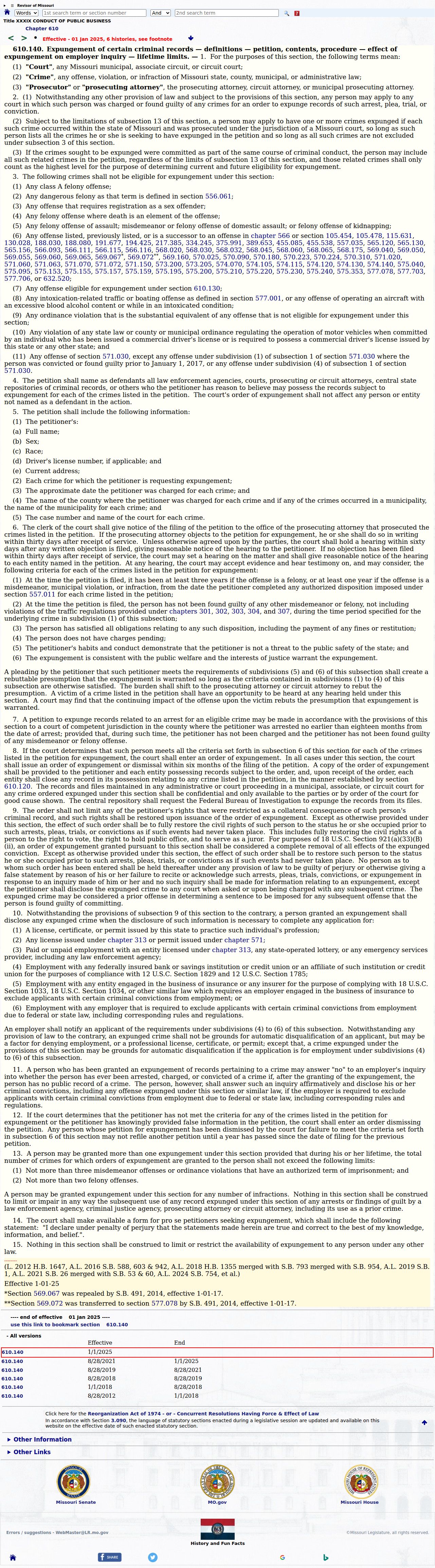
RSMo § 610.140 governs expungement and the confidentiality of records after a qualifying order.
Protected Material May Sit Behind a Public Header
Some case material sits behind a wall even when the header looks public. The juvenile-record statute spells out a restricted class of juvenile court records. Its official text appears in the page just ahead. Access still turns on what the court, the rule, and the statute allow. A search result alone grants nothing.
Rule 122 guidance points the same way. Written reports, social records, and evidence in juvenile and family matters fall outside ordinary public access.
Court Operating Rule 4 names other protected categories: psychiatric evaluations, presentence investigations, probation and parole material, sealed files, and expunged records. A dismissal is not automatically an expungement. An expunged record is not an ordinary public result. The expungement statute spells out the statutory confidentiality that follows a qualifying order.
When an entry or document is unavailable, ask the Circuit Clerk. The clerk can explain the permitted public route. The clerk can also say whether a redacted version exists and whether a court order or authorized status is required. No public search overrides a sealing order. Keep a copy request focused on public material. A broad file request without a case number or date range slows the response. It never expands access to confidential records. For historic material, the clerk can also say whether it remains locally held. If not, it should be traced through Missouri State Archives.